K-12 Superintendent, reformed IT guy, educator, 1:1 evangelist, life long learner, father, husband, geek, ex self-propelled field artillery turret mechanic, GCT, CCTO, INFP
We’re faced with a big decision in the next few months, what laptop will we upgrade our teachers to next. They are all rocking the 13″ MacBook Air from 2014 and aside from some battery issues on the oldest ones, I must say, the devices have held up really well. In fact, if Apple had simply upgraded the processors in the old MacBook Air chassis and maybe thrown in a bit higher resolution screen, we would have already made the decision.
But, unfortunately, Apple had to go and “improve” on what was arguably already the best laptop ever made. So, I’ve been demoing one of the new MacBook Air 2018 models for the past week and here is where I’m at:
Pros:
Nice Screen – brightness seems fine in daily use, despite the reviews
Small Bezels!
Decent performance (although I’ve seen Chrome stutter a bit here and there)
I can use my Pixel phone charger to charge it!
Speakers are nice
TouchID Power Button is awesome
Cons:
I really miss the old MacBook Air keyboard – The travel is non-existent and I am missing more keys when typing than usual
No MagSafe adapter to save me from myself
Surprisingly heavy, especially for the reduced size and when compared to the old MacBook Air 13″
Headphone jack on the right hand side (that’s just wrong)
Apple Logo doesn’t light up – gone is any external indicator that the machine is on, or sleeping when the lid is closed.
So, is this the device for 350 educators to use day and in day out in their classrooms for the next 4-5 years? At this point, I am not sure. I think for next steps it would make sense for use to order a few more and put them in the hands of teachers in the classroom to find out. Given the magnitude of this decision, I think we need some heavy classroom use before we can make an informed choice.
On another note, from an organizational perspective, I wish Apple would think about more than just the individual user sometimes. We have invested in an entire system of spare power adapters and display dongles to support our fleet of MacBook Airs. Regardless of what device we end up moving forward with, we are going to have to replace all of that with new accessories. Thanks USB-C.
With this new MacBook Air, I feel like we’ve taken one step forward and two steps back. We had the best keyboard on the market. We had MagSafe, which was just brilliant at saving ourselves from ripping out the power cord. We had a thin and light chassis that really only showed it’s age around the screen resolution and bezel size. In the end, we gave up a lot of user friendly innovation and all we really got in exchange was a TouchID enabled power button.
One thing is certain, ever since Apple got rid of the polycarbonate MacBook, they’ve continued to limit the options for Education if we want to stay on the Mac OS platform. Maybe we should be testing teacher Chromebooks instead…
Every student has access to an Internet connected mobile device. Now what?
If you are at a district that has entered the 21st Century and made the decision to provide technology access to every student, congratulations, you’ve taken you’re first step into a larger world. What happens in that larger world is up to you. It can look a lot like before, and probably will at first. But if you embrace change and explore the possibilities, you can start to transform reality into something new and relevant for the age of information overload and the 4th great industrial revolution. In the slide deck below, I walk through the possibilities we’ve explored and the change we’ve experienced over the past four years at Union School District, where technology is now ubiquitous and we’ve moved past the initial tech as a tool phase into the exciting world of future ready learning.
This guy John Eick, @John_Eick, (pronounced IKE not ICK), just blew my mind for the second time in less than a month. We were fortunate enough to have John keynote our district PD day a few weeks ago and I thought he rocked the house then, but yesterday as the Lead 3 keynote, he brought the house down. In about an hour, from a tiny stage in front of a crowd of school administrators seated at round tables eating lunch, John taught a master course on organizational change leadership. We’ve all read the standard leadership books but what Eick did in an hour with an imaginary Rubber Band, Hollywood worthy sound effects and an acronym, is distill all that book theory into 7 practical steps a school administrator can start working on TOMORROW. And it’s not rocket science. To use another Jon’s terminology, Eick has built a protocol for educational leadership that gets right to the point. So, if John isn’t writing a book, he should be, because his STRETCH ideas are some of the most succinct and accessible how-to’s for being a change leader I’ve heard, ever. And we need more practical, real world ideas for educational leaders if we’re going to change the system to meet the needs of our kid’s futures. Status quo is not an option.
In April 2010, Danny Silva and I sat down and recorded the first episode of the Small School Big Tech Podcast. The premise was simple, two educators talking about our experiences implementing technology in our school district. Along the way we chronicled our 1:1 roll out in real time and got to meet and talk with a bunch of awesome educators. Danny dropped off in 2011 when he left for CUE and Mike Magboo stepped in to pick up the slack. Five years and 66 episodes in, Small School Big Tech had run it’s course. I posted the last episode on March 18th, 2015.
Since that last episode, I’ve kept the Small School Big Tech website and domain name while watching as the traffic dropped off to almost zero. Coming up on three years since the last post, I think it’s time to let it go. I’ve unchecked the Auto-Renew option in Hover for the domain and with that done, I now have a few months to figure out what, if anything, to do with the content.
All of the audio files are hosted on Archive.org, so they will essentially live forever, minus the index associated with the small school big tech web site itself. I’ve been debating sucking all the episodes from Small School Big Tech over to this site. I know it will break all the external URL references like iTunes and Feedburner but at least the references to the Archive.org links will exist somewhere in one place. What I’d really like to do is create one page with every episode title and link on it, old school web index style.
Or maybe I’m being nostalgic and should just let them go. Leave them to live on at Archive.org forever, to be discovered, or not, in the ever expanding historical record of the Interwebs.
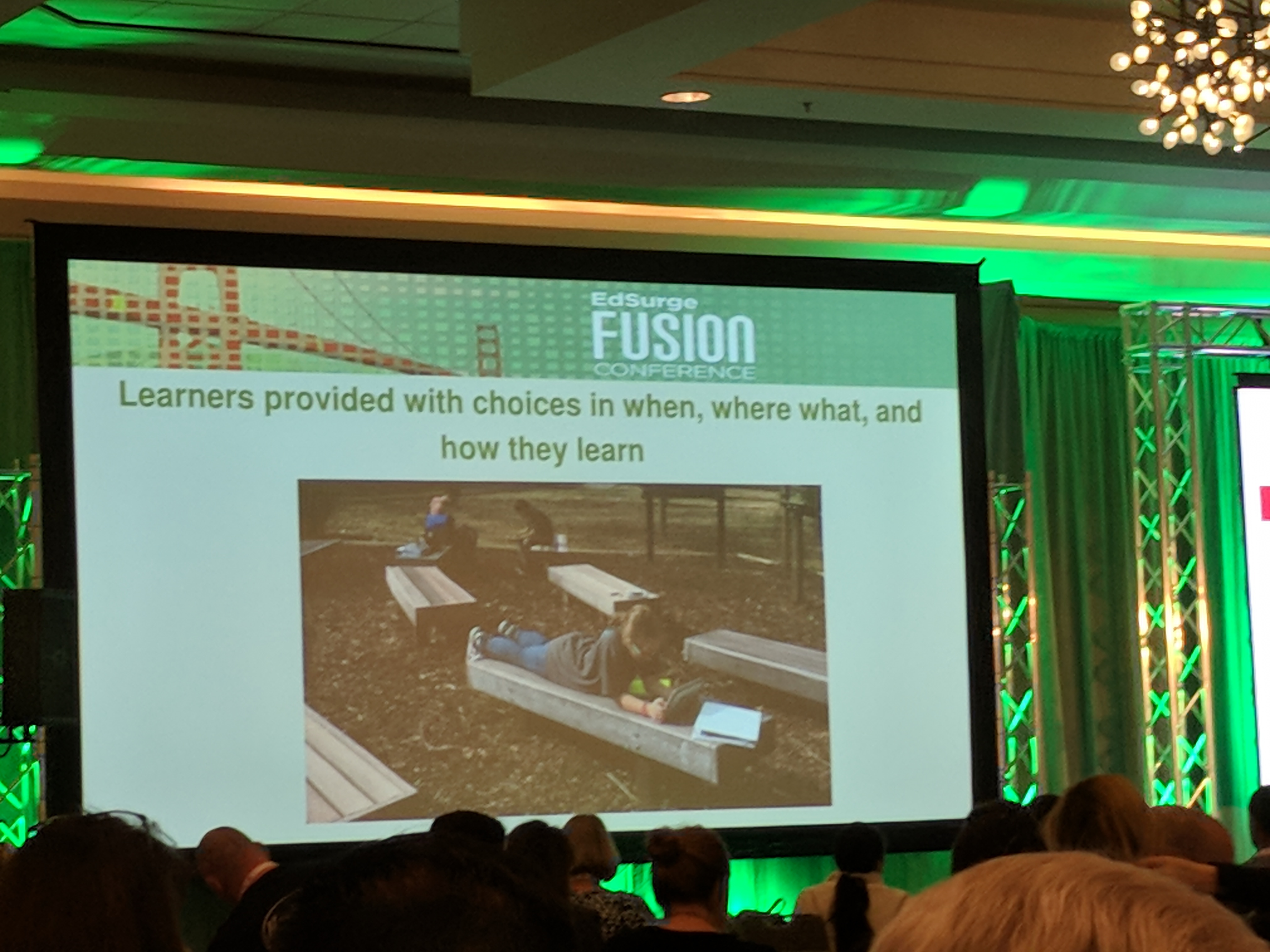
Last month I attended the EdSurge Fusion Conference where the focus for the event was on Personalized Learning. Right off the bat, the presenters acknowledged that we lack a common definition for what Personalized Learning is, what it looks like and what it might mean for the future of education. The idea behind Personalized Learning isn’t new. Since the one room school houses of old, Personalized, Differentiated, Individualized Instruction has been sought after, nostalgically it seems, in response to the success of the factory, one sized fits all model of education. It’s not a new idea, Personalization has just been very hard to do well at scale in the current system.
Personalized Learning represents the perfect intersection of Technology and Education. It is the space where Technology will eventually (finally?) disrupt education as we know it, the way technology has disrupted almost every other sector of our lives because technology has the potential to make Personalization at scale a reality. Essentially, Personalized Learning is the disintermediation of the system of education and, if the big thinkers at EdSurge are right, it will be powered by AI (Artificial Intelligence).
My last few EdSurge events had been vendor heavy and education leadership light, with a scattering of messages about education reform and the startup culture driving change from diverse approaches with technology. This event was different. At Fusion I heard a unified front from vendors, philanthropists and educational leaders alike around the promise of Personalized Learning. AI is going to power Personalized Learning of the future, and big money is being concentrated around this idea to make it a reality.
What learning looks like powered by AI, with Natural Language Processing (think Siri or Alexa for schools) and the world’s information being sucked up by Big Data, one can only guess. And yes, Siri, Alexa and Google Assistant all pretty much suck at accepting spoken commands, but if we’ve learned anything from Moore’s Law over the past 15 years, it is that compute power gets faster and cheaper exponentially. Natural Language Processing and AI will get better and fast. With the big vendors and philanthropists converging on Personalized Learning, educationally relevant Big Data will form a trifecta that will, in the next 5-10 years begin to transform education in a way technology has never been able to do before.
This is not the next overhead projector, or the next interactive white board or even the next 1:1 device. This is technology that will understand the spoken word, search the sea of infinite information available on the Internet and return a relevant answer. Call this vision version 1.0, which we’re already living in, by the way. In version 2.0, AI will add contextual understanding and factual information retrieval will become faster and more accurate. Relevancy will increase and it will seem as though AI knows what information you need before you do. Information will be presented in ever increasingly easily understood interfaces.
Versions 3.0 is where it will get really interesting. When AI starts to provide relevant, real time feedback on student learning. This will be the shift from teaching content to teaching learning strategies. When AI makes this jump, and it will make the jump, learning as we know it will change forever. This is the kind of change brought on by the modern industrial model of school or the cheap information access made possible by the printing press before that. Natural Language Processing + AI + Big Data + ubiquitous Internet access and student devices will make learning truly Personalized: Anywhere, Anytime, with Real Time Feedback, Just-In-Time Context, formatted to fit the needs of each individual student. Think an Iron Man “JARVIS” for every child. Far out there, I know, but not so far out that we can’t begin to see it now.
If you had asked me a month ago how soon I thought we’d see the Vulcan School from Star Trek, I’d have guesstimated 20-30 years. Certainly after my 1st grade graduated high school. But after listening to a bunch of smart people at EdSurge Fusion describe how they are directing their efforts (Time, Money, Political Capitol) on AI powered Personalized Learning, focusing on student centered learning paired with the exponential innovation of the technology revolution, I came away from EdSurge thinking the future is much closer than I imagined.
The education system faces many challenges. Technology has been nipping at the heels of education reform since the Internet was invented, but the convergence of AI and Personalized Learning will challenge the system like never before. Once an AI powered device learns to “teach”, what will become of School?


 There is no box