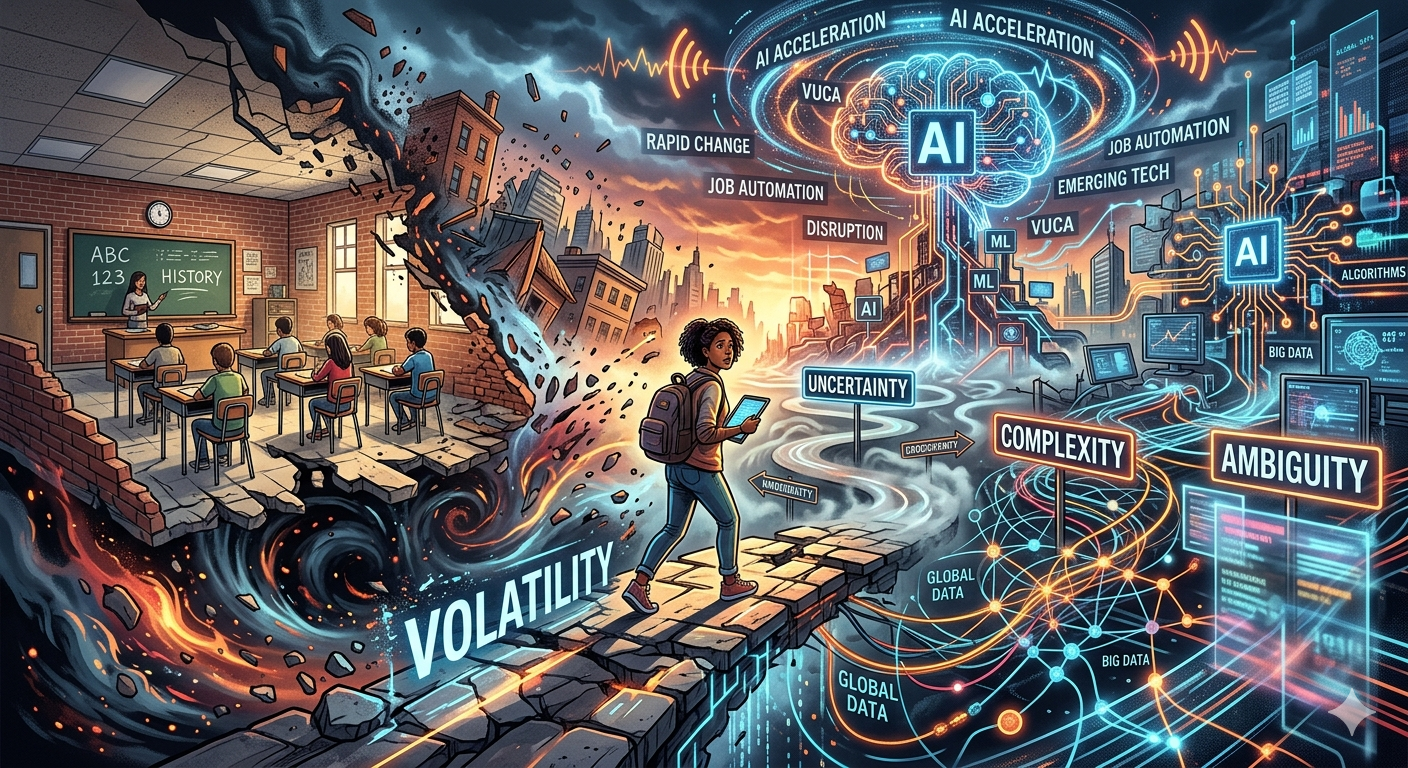
Nearly six years ago—July 25, 2020—I recorded RebootED Episode 58: “VUCA, VUCA, VUCA!” with my co-host Dr. Mike Vollmert. We were deep in the fog of early pandemic reopening debates. Schools everywhere faced impossible choices: in-person vs. remote, safety protocols vs. learning loss, equity gaps widening by the day.
Dr. V framed it through the military/business lens of VUCA—Volatility, Uncertainty, Complexity, Ambiguity. Volatility in daily case surges and policy whiplash. Uncertainty about what “safe” even meant. Complexity in layering health, academic, social-emotional, and fiscal needs. Ambiguity when experts disagreed and data changed hourly.
We referenced Dr. Michael Osterholm’s sobering updates on school reopening, Eric Topol’s JAMA podcast insights, and a New York Times piece highlighting how reopening was “way harder than it should be.” Our conclusion? No clean answers—just the reality that leaders had to act amid chaos, communicate transparently, and adapt relentlessly.
Listening back now, in March 2026, it hits differently. VUCA didn’t end with the return to classrooms. It evolved.
Today’s education landscape still pulses with volatility: budget shortfalls from enrollment declines, teacher shortages, curriculum battles over AI enabled cheating and traditional pedagogy. Uncertainty lingers in federal policy flux, state funding formulas, and the long tail of learning recovery. Complexity multiplies with AI tools promising personalization while raising equity, privacy, and job-role questions. Ambiguity surrounds the “what now?” of post-pandemic schooling—do we double down on recovery interventions, accelerate toward future-ready skills, or both?
The episode’s core takeaway feels timeless: Leadership in VUCA isn’t about finding certainty; it’s about building capacity to thrive without it.
Three enduring lessons from that 2020 conversation that guide me today:
- Embrace discomfort as the default. In 2020, we taped floors and rearranged desks for distancing. In 2026, we’re seeing AI impact everything we thought we knew about skills, knowledge requirements and preparing students for the future. The discomfort of change isn’t a bug—it’s the feature that forces innovation. Leaders who normalize adaptation build resilient teams.
- Communication is oxygen. Back then, daily emails and town halls were lifelines amid fear. Now, with online rumors swirling, AI slop flooding social media and communities polarized, clear, consistent, compassionate messaging remains non-negotiable. Share what you know, own what you don’t, and invite input. Transparency builds trust when ambiguity reigns.
- Act, learn, iterate—fast. We didn’t wait for perfect plans in 2020; we prototyped, failed forward, adjusted. The same mindset applies to piloting AI tutors, rethinking grading in competency-based systems, or addressing chronic absenteeism. VUCA rewards agility over perfection.
As educational leaders, we no longer get to hope for stability to return. We lead in perpetual motion. Episode 58 captured that raw moment of realization: the world won’t “go back to normal.” It demands leaders who see volatility as opportunity, uncertainty as invitation to collaborate, complexity as a call for systems thinking, and ambiguity as space for vision.
Dust off the archive if you haven’t revisited it (still free on Archive.org). The conversation hasn’t dated—it’s sharpened by time.
What’s one VUCA element dominating your district right now, and how are you turning it into momentum? Share in the comments—I’m all ears.
#Leadership #VUCA #EdLeadership #FutureOfEducation #K12 #PostPandemic #AIinSchools
Dr. Andrew Schwab is a K-12 Superintendent, former Chief Technology Officer, and advocate for future-ready schools. He believes that education is the gateway to opportunity and that leadership must be human-centered and student-focused.

 There is no box
Leave a reply to Lisa DeLapo Cancel reply