I think I have been taking this whole blog thing a bit too seriously. I mean really, who’s going to read this thing anyway. So rather than be super serious about my posts I think I should keep it fresh by posting less but more often. looking through my drafts, I have a dozen things I started to write but never finished. This is not a novel or the New York Times. It’s a dinky little blog. Maybe it is time to start treating it like one.
There is no box
thinking out loud about technology, education and life
recent posts
- Revisiting “Space Space and More Space”: What a Pandemic-Era Learning Spaces Discussion Still Teaches Us in the AI Age
- Is “rigor” just code for “more harder”?
- VUCA Never Left the Building: RebootED Episode 58 Reminds Us Leadership in 2026 Is Still About Navigating the Unnavigable
- 13 Years Later: Daniel Pink’s Insights on Motivation Are More Relevant Than Ever in the AI Era
- 2012 Vision Still Holds: Redefining Public Education in the Age of AI and Perpetual Change
about
-
In case you haven’t heard (and I doubt you have) we here at Le Grand have embarked on a grand netbook experiment. Its a funny thing really because up until a year ago we didn’t have any plans to deploy netbooks on campus. But then something happened. Something wonderful. Acer sent us seed units for free. No POs to sign, no paperwork of any kind. Just a quick phone call, would you like to try a netbook, yes? We’ll ship it right out. No muss, no fuss. And then, they did it again. And as if by magic our little district had 4 netbooks to try, for what seemed like forever. And even better, if we wanted to keep them, we paid 1/2 price and if not, we just shipped them back. It was so easy, so simple, so impossibly friendly it put a big warm fuzzy feeling in my heart every time I saw one of those little Acers tucked under someone’s arm as they walked around campus. That warm fuzzy feeling was so great that when it came time to order netbooks for our pilot project, we unanimously decided on Acer. Afterall we had been using them for several months, hassle free and we didn’t exactly have time to go out and test a whole bunch of different netbooks. You know how planning goes in School Districts. We’ve got money, the end of the year is here. Buy them, NOW!
Cut to present day and we are considering expanding our pilot into more classes. This time we do have the time to look at alternatives, after all we know what the Acers can do. We’ve lived with them for almost a year now. What we don’t know is what else is out there and given how rapidly Acer changes models it would be nice to settle on something a bit more stable. But so far there has been no warm fuzzy feeling from any of the other vendors. In fact it has been the opposite. Everyone wants a PO and a trial period. Dell wants their netbook back in 21 days, CDWG is better and will send me anything for a 30 day hands-on. Lenovo wants me to call them back. I already sent an email saying I wanted to tryout something similar to an Acer D250, thank you, do we really need to talk? Can’t you just send something out?
I want it to be easy. Easy like Acer. I don’t have time for POs and keeping track of deadlines on trial periods. These things are cheap. Why not just seed them out? Is one unit really going to hurt you? Spread some good will and cheer this Holiday season and let us spend a few months getting to know your netbook. Acer did and those 4 units that we had in hand for months and eventually paid for turned into 60 units purchased at full price and left us with a tendency to buy Acer first. In fact if Acer could just keep a model number for longer than 3 months, I’d probably not even be looking at alternatives right now. But I am curious. I would like to see what else is out there, I mean we are talking potentially hundreds of units moving forward and some hardware consistency would be nice.
I am not asking for a free handout. But I am asking for free from hassle, easy, simple, a call or an email and it arrives one day ready to be used and abused. Willing to stay for a long term commitment. I’m not going to make a decision based on a few weeks of hand holding. Given today’s budget, do I spend the few dollars we have looking at alternatives or do I save that money and buy more Acers and just deal with the model changes? Acer hooked us with their seed program and it seems like no one else is really interested in our business. So what is a small school district to do?
-
We use the OpenVPN module in the Untangle Open Source Network Gateway for remote access at our school district. Everything had been working flawlessly for over a year until suddenly right before I was set to leave for a two day conference, I turned on my Windows 7 RC1 Acer Aspire One netbook, fired up the OpenVPN GUI client and then proceeded to fail at connecting to my remote clients using RDP. I immediately checked my desktop Windows 7 RC1 install and found the same problem. Long story short, somehow I had lost the ability to resolve my hostnames to their correct private IP addresses while connected to the VPN. The work around for my trip was to connect using IP addresses, which I duly noted before leaving.
Upon my return I decided to troubleshoot the problem. I was able to rule out a server side issue because 1) no settings had changed since the last time it worked and 2) my Hackintosh OS X desktop system running the OpenVPN client Viscosity worked just fine. So to rule out my netbook as the culprit, I dusted off my old Dell Inspiron 6400 laptop, which is also running Windows 7 RC1, and tried the OpenVPN GUI client on it. I got the same frustrating thing, the VPN client connected fine, I just couldn’t resolve my internal DNS names correctly. I was wondering if this was a problem with the OpenVPN client I was running (2.1rc15) or what else could have possibly changed on both these systems to have this affect. I decided to try my last instance of Windows 7 RC1 and so fired up Virtual Box on my Hackintosh, started OpenVPN GUI and was pleasantly surprised to connect right away with RDP using my internal hostnames (fully qualified, of course).
Now I knew it was something with Windows 7 on both my desktop, netbook and laptop. But what could be affecting all three? Many moons ago, Windows used to have odd problems associated with NIC binding orders. I happened to notice in the ipconfig dump on the Virtual Box host that the TAP-Win32 adapter was listed first and as this was the NIC with the correct DNS settings to resolve my internal hostnames it looked like something I should check on the other systems. Sure enough the desktop, netbook and laptop all had the TAP NIC listed in second place when I ran ipconfig /all. Ah ha! A quick google search for how to change Windows 7 NIC bindings (not where it used to be) turned up this gem from dillonator:
Get to the Network Connections page under the control panel. (If you’re looking at the Network and Sharing Center, click on Change Adapter Settings.) Now hit the “alt” key and you should see the menu pop up. Click on Advanced and you should know where you’re going from there
I love the fact that you have to press the ALT key to see the advanced settings options. After moving my TAP-Win32 adapter (Local Area Connection 3) on my desktop to the top of the Connections list I was once again able to RDP into my remote hosts using their fully qualified domain names (FQDN).
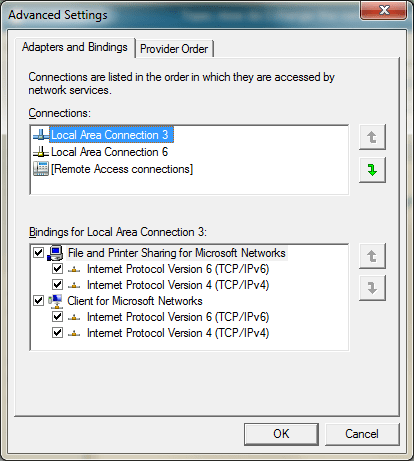
I have no idea why or how the binding orders on three of my four Windows 7 RC1 installations changed or why my Virtual Box host was unaffected but I am happily VPNing with OpenVPN once more. Any ideas on how this might have happened, please leave a comment. Thanks.
-
U.S. Secretary of Education Arne Duncan is calling for a change in how perspective Teachers are taught in our nation’s schools of education. I am a big fan of change and think it is great that the Secretary is addressing one of the foundations of the American Education System. Not having gone through one of these schools of education myself however leaves me perhaps missing the point. Any change in these institutions is not going to have a real effect for several years to come and it will do nothing to address the plight of the current generation of teachers now serving in the nation’s classrooms not to mention their students.
So let me jump outside the box and offer a more radical prescription for change. I think everyone agrees that while there are a myriad of factors that can affect student learning, teachers have the potential to have the most impact. I also know that Duncan is pushing for pay for performance as a means to possibly motivate good teachers and move out “bad” ones. Watch Dan Pink’s TED talk about the Science of Motivation and tell me you still think pay for performance is a good idea for the 21st Century.
I don’t think pay is the issue but it makes for good politics. So how then do you get all teachers to do better? I think the answer is simple and yes, it will cost money. What good teachers need is more time to prepare and collaborate with one another. What struggling teachers need is more help and support (basically more time). In a world where 50 minutes out of 450 is spent on “prep” and you are lucky to get 5 days of professional development a year, how can anyone be expected to keep their head above water, let alone master their profession and impact students without being an extraordinary person. I think we’ve built failure into the system at a fundamental level.
If it takes extraordinary effort to be a great teacher, how can one realistically expect every teacher to be great. We can’t all be Teacher’s of the Year. So changing the schools of education won’t make every graduate a great teacher (not that they shouldn’t change for other reasons but lets stay focused here). I think one of Secretary Duncan’s other ideas, the longer school day/year, does have merit. Extending the school day and year could address several issues if done right. Dedicating some of that additional school time for teachers to develop their skills and adjust their instructional strategies and curriculum would help all teachers (and students); both the great and the mediocre. More time for collaboration would also allow for implementing innovations like Danny Silva’s idea for 20% time in class which are now next to impossible given the lack of planning time in today’s system. More hours at school would also have the added benefit of addressing pay, because no one should expect teachers to work additional days for free even though to be successful in the current system you absolutely have to.
But how does extending the school day/year address the problem of the teacher that just won’t put in the effort? I think just the additional work time would weed out a subset of teachers. Add to that the requirement of continuous professional and course/curriculum development (a metric less subjective than observation) and you’ll start to see the bulk of the coasters and survivors drop away. The institution of school has provided cover for under performing teachers (and administrators to be perfectly honest) because it does not promote (as a general rule) the development of teachers as professionals. It is easier to hide away in a classroom for years teaching the same thing the same way than it is to improve, grow and change. And everyone knows most of us are predisposed to take the easy route.
As a second year VocEd teacher that came to the profession in a round about way, I can honestly say that teaching is the hardest job I’ve ever had. And by hard I mean it tests me in new ways every day. It forces me to think, to be creative and to challenge my preconceived notions on a daily basis. I don’t know if this is sustainable in the long run, but I sure hope it is. What I am proposing is a change so radical it calls for taking away the easy option and treating teachers like the professionals they should be. If we are trying to build an education system for the next century, which I believe we should be doing, according to Dan Pink, the focus should be on empowering teachers through autonomy, mastery and purpose. In that kind of environment, mediocrity and apathy cannot survive. Pay has nothing to do with it.
-
I recently watched the Triumph of the Nerds (again) and was struck by the role Intel played in the development of the PC market. Intel developed microprocessors and dominated the market but they were not the ones that developed the PC, arguably the most important device ever to utilize their chips. Intel built a platform (the x86 microprocessor) that enabled Apple and IBM to basically invent the PC market (sorry Ed Roberts). Of course Intel didn’t do too bad either. Until AMD came along they were the dominate chip maker, so much so that AMD basically copied their x86 architecture and made Intel compatible microprocessors.
So what does all this have to do with Google? Well, as a user of Google services such as gmail, reader and search I think it is easy to mislabel Google as a services company. While it is true that many of their services do compete directly with Microsoft or Yahoo, Google is more than just a collection of services. Take a look at their ingenious server rack design or their data center in a box and you can see their vision of platform. Google’s very own microprocessors if you will. Google has built a huge platform, a Google OS, on top of which they run search and many other services.
Just as Intel has influenced the PC industry with their innovative chip designs and allowed for the explosive potential of the desktop computer, so too I believe will Google’s innovative interconnected processing platform have a huge impact on the future of computing for decades to come. I think we have yet to see the Apples and IBMs emerge that will take advantage of the Google platform in the same way the PC did Intel processors but with the introduction of Google Wave as an open standard, I think it is only a matter of time until we do.
And what of Microsoft in all this? They are going to be late to the party as usual.
-
There is on ongoing discussion at my high school about what we should and should not be teaching in our Business Applications classes. The same curriculum has been in place for several years (at least six) and consists of typing, Microsoft Word, Excel, Powerpoint and very basic computer history, Internet search, hardware and Operating Systems information. On one side of the discussion is the status quo, open to some minor changes but generally OK with the sequence and overall objectives of the classes. On the other side are those of us that would like to see the classes transformed into something much more.
Pretty much all freshmen take Business Apps I and for this reason I believe it to be a critical class to student’s future success. This is the one opportunity we have to give them the knowledge and skills they need to effectively use technology over the next four years as they navigate the challenges of High School. Right now, we teach them how to use Microsoft Word, Excel and PowerPoint. We teach them how to find images on the Internet and how many bytes a floppy disk holds. We teach them how to save files to the hard drive and how to print assignments to be turned in. We teach them how to follow step-by-step instructions in a book with exercises that have no relevance to them whatsoever. We teach them all the skills they need for the workplace of a decade ago.
What we don’t teach them in the class is how to compose an email. We don’t teach them how to find and critically analyze information on the Internet. We don’t teach them how to collaborate online, how to responsibly share information or how to backup their files to the cloud and access them from home later. We don’t teach them how to use alternative applications like Google Docs or Open Office. We don’t teach them about creative commons, open source or building their brand. We don’t teach them how to live and work in a Web 2.0 world. And I think we should. Especially in this class; the only computer class they are required to take to graduate. These skills are too important to their futures not to.
It would be nice if these were also the skills student’s needed to succeed in our school but I would be fooling myself if I said they were. Writing a three page paper in Word, making a PowerPoint with lots of images and animations and wild colors, charting their test scores in Excel and saving files to their network drive are really the only skills they need to get through their four years here. In most classes anyway. Some of us are pushing the envelope. We are teaching our students how to use Google Docs to collaborate. We are teaching our students how to turn in assignments in Gmail, how to upload files to Moodle, how to search for useful information on the Internet and how to create presentations with tools like Animoto, Xtranormal and Prezi. We are teaching critical thinking, creativity, communication and collaboration using the tools available to us through the Internet and Web 2.0.
I see the updating of the Business Apps classes as a critical step in our school’s journey into the 21st Century. With an Internet connection, a computer and an idea anyone can start a company, find their voice, write a book, build a community, make a difference and change the world. These opportunities are what is being left behind in our Business Applications classes as they stand today. The tools are there, they are free and they are waiting to be used. Teach the students how to use them and they will do the rest. Last year I introduced Animoto to the students in my classes and within a month, students were doing Animoto presentations in their English classes too. Their teacher’s didn’t have to know how to use Animoto to accept them as assignments, they just had to be willing to make a change and decide that it was OK to do an Animoto instead of a PowerPoint. Change is always a struggle. But I think it is a struggle worth fighting.
-
One might look at my last two posts and ask, “What’s that stuff doing there?” Well, I have decided to start posting my class objectives for the week on my blog as a way to capture them in time. You see I post my objectives in Moodle at the top of my courses every day:
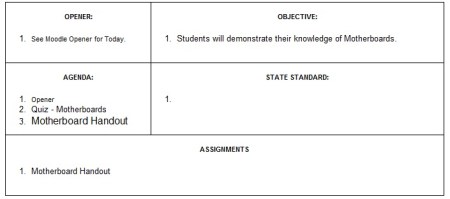
class objectives for the week in Moodle Which is great. I really like having this information right at the top of the Course. The problem is that I am losing the previous information as soon as I update it. I have seen teachers logging this information in binders and books. I can’t quite bring myself to go analog on this. Not with Moodle already there. But I haven’t found a way to keep this information in Moodle (where I would really like to store it) and easily reference it in the Course Topic section.
I have experimented with embedding Google Calendar and entering the information as an event for each day but it felt clunky. I really like to have a database back end with a simple web front end that I could pre-load with objectives and assignments and have it populate automatically. I just don’t have the time right now to do that. So for now, I’ll capture the information in my blog. At least I will be able to go back and find the information when I need to.
-
Computer Systems
Objective: Students will be introduced to microprocessors.
- What is a microprocessor
- Basic history of the microprocessor
- Intel vs. AMD
- Clock speed and bus speed
- Sockets and Pins
- Pairing a processor with a motherboard
Computer Programming
Objective: Students will learn about story-boarding and program design.
- Scenarios and story-boarding
- Visual story-boarding
- Textual story-boarding
- Story-board to program code
- Intro to basic programming principles
-
Computer Systems
Objective: Students will be introduction to motherboards.
- What is a motherboard
- How does it work
- The components of the motherboard
Computer Programming
Objective: Students will learn about Alice controls for objects and cameras.
- Setting the stage
- Posing Objects
- Camera Controls
- Modifying Object Properties
-
The heroes in the matrix all have cool names; the names they have chosen for themselves. Tom Anderson is Neo, and you have Morphius and Trinity too whose given names we never know. Online I am anotherschwab, the name I chose for my first web based email account because I got tired of searching for an available combination of Andrew and Schwab. I did not want to be aschwab73 or atschwab10 or even andrewschwab2. After a dozen tries I finally said to myself, I guess I am just anotherschwab and that was the name I chose. It is the name that has stuck with me online for over 15 years.
Are we too becoming like the characters in the matrix, known online not by our given names but rather by our chosen names? Google Andrew Schwab and you get a singer in the band Project 86 as the top hit. Its not me. Google anotherschwab and you get my profile on twitter right as the top result. At this point I can’t even imagine using any other name online.
And what does this mean for my daughter’s online life? Should I be creating accounts for her now when she is three to be sure she gets the name given to her at birth or should I let her have the same experience of finding her own name? Of choosing her identity on the net and so walking the same path as Neo, Morphius, Trinity and anotherschwab?
 There is no box
